-->

Pages


LATEST POSTS

Friday, May 4, 2018

Business Intelligence Jobs Entry Level

Description For Business Intelligence Jobs Entry Level


What you ll be doing...


Join our Information Technology team where you will work on new technologies and find ways to meet our customers needs and make it easy for them to do business with us. You will use functional expertise to act as an advisor to management and make recommendations on more complex projects. You will use professional concepts and company policies & procedures to solve a wide range of difficult problems creatively and practically.

We are looking for an exceptional Business Intelligence Analyst to work on our Network Analytics and Reporting platform (NAR). NAR is a business intelligence and data warehouse tool used for network analysis and reporting needs across Verizon. You will have the opportunity to work with cutting edge business intelligence tools such as Tableau, Oracle Business Intelligence Enterprise Suite (OBIEE), Oracle Data Integrator, Golden Gate, and Exadata. This position will focus on network analytics, data integration and creating executive dashboards and reports.


What we re looking for...


You ll need to have:


    Bachelor s degree or one or more years of work experience.
    One or more years of relevant work experience.

Even better if you have:

    Experience with all phases of the Software Development Lifecycle, including system analysis, design, coding, testing, debugging and documentation.
    Knowledge with SQL.
    Knowledge of data mining, data modeling and data manipulation.
    Knowledge of business intelligence tools such as Tableau.
    Knowledge of ETL principals.
    Experience with Python.
    Teamwork & collaboration skills to work across organizations and lead cross-functional teams.
    Communication & stakeholder management skills.
    Problem solving skills to develop quick yet sound solutions to resolve complex issues.

7 Most Preferred Two-Factor Authentication Solutions

What makes a two-factor authentication solution convenient for an enterprise and which products should companies consider to implement? In this article, we will cover 7 most suitable data protection tools offered by well-known two-factor authentication service providers.

A standard procedure of getting access to a network account consists of entering login details: a login and password. This is a single factor authentication. Two-factor authentication (2FA) is an additional data protection measure that implies an extra step to a common log-in procedure. Unlike a single factor authentication requires users to enter password and login (something they know) to get access to data, 2FA may require entering one-time password received on a personal mobile device (something users have) or inherence confirmation, e.g. biometrics (something users are).

Two-factor authentication solutions allow companies to better protect their data and avoid unauthorized access to it. Though, a set of features and characteristics of every tool can be totally different from vendor to vendor.

SecurAccess

SecurAccess is a tokenless two-factor authentication system developed by SecurEnvoy specifically for user-identification that involves remote access. This solution will be especially useful for those companies that manage remote teams. Both small and medium enterprises can take advantage of Secure Access, as well as large corporations can since its deployment can scale up to 100,000 users per hour.

SecureEnvoy’s product can send passcodes to any mobile phone without SMS delivery delays. It allows companies to enhance their list of users to include both third-parties and consumers besides own employees. Therefore, in case your company has to provide its partners with access to corporate business resources, then SecurAccess would be a convenient solution.

SecurEnvoy’s tokenless authentication brings various benefits to companies that strive to save their budget on the 2FA solution deployment and helpdesk administration. With SecurAccess, they can avoid expenses on token deployment or replacement as well as reduce helpdesk administration cost since their users won’t face token resynchronisation or PIN resets.

The solution will cost you about $1,650 annually for more than fifty users.

Features

  •     Sending out passcodes via SMS, VoIP phone calls, or email;
  •     Unlimited number of supported LDAP servers;
  •     Supporting all popular web SMS gateway services, such as Vfirst, T-Mobile, aql, and HSL;
  •     Overwriting passcodes (automated replacing old passcodes with new ones);
  •     In Case of Emergency feature that implies sending notifications to privileged users if  some nonstandard situation causes an access denial.
  •     Integration with various servers, such as Microsoft’s Adam, Fedora, eDirectory, Sun Directory Server, and AD.

Okta Adaptive MFA


Okta Adaptive MFA is a multifactor authentication (MFA) tool based on a single sign-on (SSO) principle. This solution is especially convenient for those companies that need to adopt cloud-based security.

The main advantage of Okta Adaptive MFA is that it can provide the right authentication factor in each particular situation. Administrators can set specific types of authentication factors for users depending on their position. The solution can send out passcodes via SMS, push notifications, use biometrics, software and hardware tokens to authenticate users.

Okta Adaptive MFA has a flexible reporting system. Admins can review suspicious activities, the number of users who have never signed into a corporate system, or the list of users with failed logins.

The implementation of this tool will cost you $3 per user monthly. With additional $3 per user, companies can order the Advanced Policy package that supports IP zone functionalities and reputation as well as geolocation.

Features

  •     Supporting both software and hardware tokens;
  •     Using biometrics as one of authentication factors;
  •     Choosing particular authentication factors for particular user groups;
  •     Automated user account creation with Active Directory logins

SecureAuth IdP


SecureAuth IdP is a tool that can be used for both single sign-on (SSO) and multifactor authentication. As a cloud-based solution, SecureAuth IdP is suitable tool for medium and large enterprises that use a wide variety of SaaS services and strive to significantly increase their network security.

The solution can provide companies with a high flexibility regarding setting authentication factors. A traditional login process implies entering both login and password at the first stage. However, SecureAuth IdP enables admins to set a custom order of requesting specific sensitive data.

The solution offers numerous 2FA options, such as smart cards, USB keys, biometrics and generating one-time passwords via a phone call, SMS, and email.

SecureAuth IdP will cost you not less than $15 per user annually,

Features

  •     Integration with SAML;
  •     Active-Directory integration;
  •     Supporting the Single Sign-On (SSO) technology;
  •     Authentication via biometrics;
  •     Complex reporting.

SecurID


RSA is one of the most known multifactor authentication providers. Its RSA Authentication Manager or SecurID suite is a 2FA tool for securely accessing applications regardless whether they are installed on-premise or located in the cloud. . SecurID has a wide set of software and hardware tokens that can be installed as supplementary authentication factors.

RSA SecureID suite also includes RSA Identity governance and lifestyle tool that allows you to generate different types of reports and provides you with a real-time access certification, provisioning, and monitoring.

SecurID supports all basic mobile operating platforms (Android, iOS, Blackberry, and Windows Phone) and it can send out passcodes via SMS, push notifications, and email.

The implementation of SecurID suite will cost you from $1 to $6 per user, depending on the package.

Features

  •     Sending out passcodes via SMS, email, and using hardware or software tokens;
  •     On-demand authentication via various protocols, such as RADIUS or Native RSA SecurID Protocol;
  •     Reporting.

Symantec VIP


The Symantec company offers  its Validation and ID Protection (VIP) service, a multifactor authentication tool which can use both smartphones and biometrics to make a login process more secure. When it comes to sending out passcodes to smartphones, Symantec VIP can use both voice calls and text messages. To provide access to network resources, Symantec VIP can also use a wide variety of hardware tokens or biometrics, such as fingertips.

The solution offers more than thirty integration methods for various apps, such as Cisco, SharePoint, SonicWall and Juniper VPNs. Furthermore, adding a few lines of JavaScript code will allow enterprises to integrate Symantec VIP with their own web applications.

Symantec offers various add-ons for their solution that enhance its capabilities. An additional risk-based analysis tool helps companies to detect fraud by analyzing particular user authentication process. For example, if some user logins in from different locations simultaneously, the system alerts about such suspicious situations. VIP Enterprise Gateway, another add-on, ensures RADIUS and Active Directory integration as well as both local and VPN access to company’s web servers based on Linux or Windows.

Symantec charges $0.25 per each passcode via voice calls and $0.07 per each text message.

Features

  •     Risk-based tokenless authentication;
  •     Authentication via fingerprint biometric;
  •     Scheduled reports;
  •     RADIUS and Active Directory integration.

CA Strong Authentication


CA Technologies is one of the most known  multi- and 2-factor authentication vendors that offers network security solutions to large- and medium-sized companies that seek tools capable of preventing identity theft. Their product adds extra authentication steps for various servers and services, such as Outlook, Salesforce, and Active Directory. It supports a wide range of software-based tokens, such as voice calls, text messages, mobile applications, and email messages. Their solution can be deployed on different platforms: a web app, desktop, iOS, Android, and Windows Phone.

CA Strong Authentication can easily integrate with a CA Identity Manager suite to ensure a higher level of security due to the special key protection technology patented by CA. The suite provides a full set of necessary administrative tools that allow companies to configure their policies, monitor user activity, and detect cyber attacks. CA Strong Authentication can report user authentication attempts, risk assessment and tracking administration details.

Features

  •     Supporting many different credentials, such as passwords, knowledge-based authentication methods, hardware and software tokens.
  •     Eliminating the risk of stolen passwords since the solutions stores no passwords.
  •     Enhanced reporting system;
  •     Integration with SAML and RADIUS;
  •     Supporting the Single Sign-On (SSO) technology.
  •     Availability as an on-premise solution and MPS-hosted or cloud service.


Vasco IDENTIKEY


Vasco, a global vendor of IT security solutions, offers one of the best two-factor authentication solutions on the market. Its IDENTIKEY Authentication Server includes multi- and two-factor authentication tools and DIGIPASS tokens. Their 2FA tool focuses on protecting access to network resources and it supports a wide range of token types, such as text messages, mobile apps, email messages hardware tokens, QR codes, web clients, and Windows software. It also supports various authentication methods, such as RADIUS, Active Directory, SAML, Simple Object Access Protocol (SOAP), and a web code.

The main advantage of IDENTIKEY Authentication Server is its reporting capabilities. It provides more than thirty different report templates that can be downloaded in an HTML, XML, or PDF format. The solution also provides many preset customizable policies that allow companies to set authentication for different user groups or internal vs. external logging in.

The standard package will cost companies from $333 per 5 users.

Features

  •     Supporting hardware tokens;
  •     Reporting summaries on user history;
  •     Supporting web server and RADIUS environments;
  •     Active-Directory integration;
  •     Web-based administration interface.

Conclusion


An IT community realized long ago that traditional passwords could not ensure reliable security for important data because they can be easily compromised. 2FA delivers additional data protection measures that strengthen company’s confidence in the safety of their information. All of the above-mentioned 2FA solutions support mobile tokens and provide flexible authentication methods. Though, some of the vendors have taken a step further and tried to focus on risk-based methods too.

If your company uses numerous Saas-based applications, then such solutions as SecureAuth IdP and Okta Adaptive MFA will be especially suitable. If your company often interoperates with third-party organizations and needs to provide them with limited access to network resources, then SecurAccess will be a wise choice. In case you consider mostly on-premise solutions, then SecurID and CA Strong Authentication are your best bets. If you appreciate both advanced reporting and fraud detection capabilities, then Vasco IDENTIKEY and Symantec VIP are worth considering.

A Guide To Common Types Of Two-Factor Authentication


Two-factor authentication (or 2FA) is one of the biggest-bang-for-your-buck ways to improve the security of your online accounts. Luckily, it’s becoming much more common across the web. With often just a few clicks in a given account’s settings, 2FA adds an extra layer of security to your online accounts on top of your password.

In addition to requesting something you know to log in (in this case, your password), an account protected with 2FA will also request information from something you have (usually your phone or a special USB security key). Once you put in your password, you’ll grab a code from a text or app on your phone or plug in your security key before you are allowed to log in. Some platforms call 2FA different things—Multi-Factor Authentication (MFA), Two Step Verification (2SV), or Login Approvals—but no matter the name, the idea is the same: Even if someone gets your password, they won’t be able to access your accounts unless they also have your phone or security key.

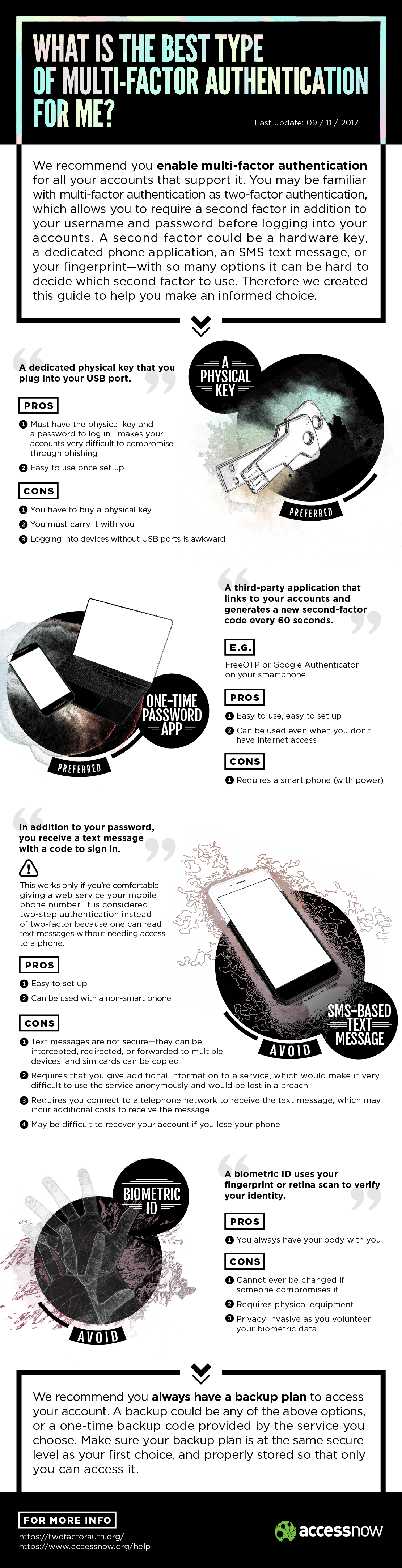
There are four main types of 2FA in common use by consumer websites, and it’s useful to know the differences. Some sites offer only one option; other sites offer a few different options. We recommend checking twofactorauth.org to find out which sites support 2FA and how, and turning on 2FA for as many of your online accounts as possible. For more visual learners, this infographic from Access Now offers additional information.
Finally, the extra layer of protection from 2FA doesn’t mean you should use a weak password. Always make unique, strong passwords for each of your accounts, and then put 2FA on top of those for even better log-in security.


SMS 2FA

When you enable a site’s SMS 2FA option, you’ll often be asked to provide a phone number. Next time you log in with your username and password, you’ll also be asked to enter a short code (typically 5-6 digits) that gets texted to your phone. This is a very popular option for sites to implement, since many people have an SMS-capable phone number and it doesn’t require installing an app. It provides a significant step up in account security relative to just a username and password.

There are some disadvantages, however. Some people may not be comfortable giving their phone number—a piece of potentially identifying information—to a given website or platform. Even worse, some websites, once they have your phone number for 2FA purposes, will use it for other purposes, like targeted advertising, conversion tracking, and password resets. Allowing password resets based on a phone number provided for 2FA is an especially egregious problem, because it means attackers using phone number takeovers could get access to your account without even knowing your password.
Further, you can’t log in with SMS 2FA if your phone is dead or can’t connect to a mobile network. This can especially be a problem when travelling abroad. Also, it’s often possible for an attacker to trick your phone company into assigning your phone number to a different SIM card, allowing them to receive your 2FA codes. Flaws in the SS7 telephony protocol can allow the same thing. Note that both of these attacks only reduce the security of your 
account to the security of your password.


Authenticator App / TOTP 2FA

Another phone-based option for 2FA is to use an application that generates codes locally based on a secret key. Google Authenticator is a very popular application for this; FreeOTP is a free software alternative. The underlying technology for this style of 2FA is called Time-Based One Time Password (TOTP), and is part of the Open Authentication (OATH) architecture (not to be confused with OAuth, the technology behind “Log in with Facebook” and “Log in with Twitter” buttons).

If a site offers this style of 2FA, it will show you a QR code containing the secret key. You can scan that QR code into your application. If you have multiple phones you can scan it multiple times; you can also save the image to a safe place or print it out if you need a backup. Once you’ve scanned such a QR code, your application will produce a new 6-digit code every 30 seconds. Similar to SMS 2FA, you’ll have to enter one of these codes in addition to your username and password in order to log in.

This style of 2FA improves on SMS 2FA because you can use it even when your phone is not connected to a mobile network, and because the secret key is stored physically on your phone. If someone redirects your phone number to their own phone, they still won’t be able to get your 2FA codes. It also has some disadvantages: If your phone dies or gets stolen, and you don’t have printed backup codes or a saved copy of the original QR code, you can lose access to your account. For this reason, many sites will encourage you to enable SMS 2FA as a backup. Also, if you log in frequently on different computers, it can be inconvenient to unlock your phone, open an app, and type in the code each time.


Push-based 2FA

Some systems, like Duo Push and Apple’s Trusted Devices method, can send a prompt to one of your devices during login. This prompt will indicate that someone (possibly you) is trying to log in, and an estimated location for the login attempt. You can then approve or deny the attempt.

This style of 2FA improves on authenticator apps in two ways: Acknowledging the prompt is slightly more convenient than typing in a code, and it is somewhat more resistant to phishing. With SMS and authenticator apps, a phishing site can simply ask for your code in addition to your password, and pass that code along to the legitimate site when logging in as you. Because push-based 2FA generally displays an estimated location based on the IP address from which a login was originated, and most phishing attacks don’t happen to be operated from the same IP address ranges as their victims, you may be able to spot a phishing attack in progress by noticing that the estimated location differs from your actual location. However, this requires that you pay close attention to a subtle security indicator. And since location is only estimated, it’s tempting to ignore any anomalies. So the additional phishing protection provided by push-based 2FA is limited.

Disadvantages of push-based 2FA: It’s not standardized, so you can’t choose from a variety of authenticator apps, and can’t consolidate all your push-based credentials in a single app. Also, it requires a working data connection on your phone, while Authenticator apps don’t require any connection, and SMS can work on an SMS-only phone plane (or in poor signal areas).


FIDO U2F / Security Keys

Universal Second Factor (U2F) is a relatively new style of 2FA, typically using small USB, NFC or Bluetooth Low Energy (BTLE) devices often called “security keys.” To set it up on a site, you register your U2F device. On subsequent logins, the site will prompt you to connect your device and tap it to allow the login.

Like push-based 2FA, this means you don’t have to type any codes. Under the hood, the U2F device recognizes the site you are on and responds with a code (a signed challenge) that is specific to that site. This means that U2F has a very important advantage over the other 2FA methods: It is actually phishing-proof, because the browser includes the site name when talking to the U2F device, and the U2F device won’t respond to sites it hasn’t been registered to. U2F is also well-designed from a privacy perspective: You can use the same U2F device on multiple sites, but you have a different identity with each site, so they can’t use a single unique device identity for tracking.

The main downsides of U2F are browser support, mobile support, and cost. Right now only Chrome supports U2F, though Firefox is working on an implementation. The W3C is working on further standardizing the U2F protocol for the web, which should lead to further adoption. Additionally, mobile support is challenging, because most U2F devices use USB.
There are a handful of U2F devices that work with mobile phones over NFC and BTLE. NFC is supported only on Android. On iOS, Apple does not currently allow apps to interact with the NFC hardware, which prevents effective use of NFC U2F. BTLE is much less desirable because a BTLE U2F device requires a battery, and the pairing experience is less intuitive that tapping an NFC device. However, poor mobile support doesn’t mean that using U2F prevents you from logging in on mobile. Most sites that support U2F also support TOTP and backup codes. You can log in once on your mobile device using one of those options, while using your phishing-proof U2F device for logins on the desktop. This is particularly effective for mobile sites and apps that only require you to log in once, and keep you logged in.
Lastly, most other 2FA methods are free, assuming you already have a smartphone. Most U2F devices cost money. Brad Hill has put together a review of various U2F devices, which generally cost USD $10-$20. GitHub has written a free, software-based U2F authenticator for macOS, but using this as your only U2F device would mean that losing your laptop could result in losing access to your account.


Bonus: Backup Codes

Sites will often give you a set of ten backup codes to print out and use in case your phone is dead or you lose your security key. Hard-copy backup codes are also useful when traveling, or in other situations where your phone may not have signal or reliable charging. No matter which 2FA method you decide is right for you, it’s a good idea to keep these backup codes in a safe place to make sure you don’t get locked out of your account when you need them.
This story originally appeared on the EFF’s blog.

Two Factor Authentication And It's Importance

Two Factor Authentication also known as Multifactor authentication (MFA) is a security system that requires more than one method of authentication from independent categories of credentials to verify the user’s identity for a login or other transaction.


An extra layer of security that is known as "multi factor authentication"

In today's world of increasing digital crime and internet fraud many people will be highly familiar with the importance of online security, logins, usernames and passwords but if you ask them the question "What is Two Factor Authentication?" the likelihood is they will not know what it is or how it works, even though they may use it every single day.

With standard security procedures (especially online) only requiring a simple username and password it has become increasingly easy for criminals (either in organised gangs or working alone) to gain access to a user's private data such as personal and financial details and then use that information to commit fraudulent acts, generally of a financial nature.

How Two Factor Authentication Work

Two Factor Authentication, also known as 2FA, two step verification or TFA (as an acronym), is an extra layer of security that is known as "multi factor authentication" that requires not only a password and username but also something that only, and only, that user has on them, i.e. a piece of information only they should know or have immediately to hand - such as a physical token.

Using a username and password together with a piece of information that only the user knows makes it harder for potential intruders to gain access and steal that person's personal data or identity.

Historically, two-factor authentication is not a new concept but its use has become far more prevalent with the digital age we now live in. As recently as February 2011 Google announced two factor authentication, online for their users, followed by MSN and Yahoo.

Many people probably do not know this type of security process is called Two-Factor Authentication and likely do not even think about it when using hardware tokens, issued by their bank to use with their card and a Personal Identification Number when looking to complete Internet Banking transactions. Simply they are utilising the benefits of this type of multi factor Authentication - i.e. "what they have" AND "what they know".

Using a Two Factor Authentication process can help to lower the number of cases of identity theft on the Internet, as well as phishing via email, because the criminal would need more than just the users name and password details.

The downside to this security process is that new hardware tokens (in the form of key fobs or card readers) need to be ordered, then issued and this can cause slowdowns and problems for a company's customers wanting and waiting to gain access to their own private data via this authentication procedure. The tokens are also usually small and easily lost so causing more problems for everyone when customers call in requesting new ones.


SecurEnvoy look to resolve this problem with Two Factor Authentication by utilising mobile phone SMS technology. With over 5 billion mobile phones in use, turning a phone into an authentication device quickly solves the need and additional cost and delays of sending out hardware tokens.

Using Two Factor Authentication without tokens is called Tokenless Authentication, patented by SecurEnvoy. This type of authentication can be considered faster, quicker and cheaper to set up and maintain across many networks.